Is AI Search SEO an existential threat to your website? Or is it the biggest new opportunity?
For many in digital marketing, the answer feels like a crisis. Traffic is down, especially for news sites. Yet, despite the chaos, Google is still the dominant source of clicks for most businesses.
To get a clear perspective on this confusing time, Search Engine Journal talked to Carolyn Shelby. She started in the industry 30 years ago and has worked with giants like Disney and ESPN. She’s seen it all.
Is AI search overhyped? Her answer is a firm No. Her message is clear: Stop panicking about the big picture and start fixing the technical foundations of your site.
AI Is Killing Clickbait, Not Content
The first casualty of the AI Search SEO era is the business model based on mass-producing cheap content to get ad revenue.
Carolyn Shelby is blunt: The “blogging for dollars” plan is no longer a smart strategy.
“It’s not viable going forward as a sustainable business strategy to spin up garbage content sites and slap AdSense all over them and then make enough money to live.”
The financial incentives have already moved. People who create great content out of passion will be fine, but those chasing quick cash are moving to platforms where the money is now: TikTok and YouTube. This isn’t a temporary trend; the core way to make money from online content is changing forever.
Think Small to Win Big: That 1% is Worth Billions
When we look at the new AI tools (like ChatGPT), they are only pulling about 1% of all search traffic away from Google, according to a recent podcast. That sounds tiny.
But Carolyn reminds us that 1% of the total search market (trillions of searches) is actually 10 billion opportunities.
“If you told me today that if I focused on nothing but ChatGPT and I could guarantee I would monopolize the 1% of traffic, I would jump on that because that is so much traffic.”
The lesson here is profound: Stop fighting everyone else for a tiny slice of Google’s crowded main page. It’s often smarter to dominate a smaller, less-competitive space (like AI answers or Bing) where users are more likely to convert into customers. This is the “paradigm shift” we must embrace.
Why Google is Moving Slowly With AI Features
Google is deliberately rolling out its AI features gradually, and one key reason may be strategic rather than purely technical. According to Carolyn, this slow rollout is linked to government antitrust lawsuits.
Google is under scrutiny for potentially being a monopoly, so it has an incentive to demonstrate that it doesn’t have total control over the search market.
By letting other companies, like OpenAI or Microsoft, gain market share in AI search, Google can argue that competition still exists. This cautious approach is politically motivated and is aimed at strengthening its legal position.
Carolyn also points out that this slowdown is likely temporary. Google’s real competitive edge lies in the vast amount of real-time data it collects through Chrome, which she describes as “the gas in their engine.”
This data gives Google the ability to innovate faster than competitors, suggesting that once their legal position is less of a concern, the Future of AI Search SEO rollout could accelerate.
How to Optimize Your Site for AI Crawlers and LLMs
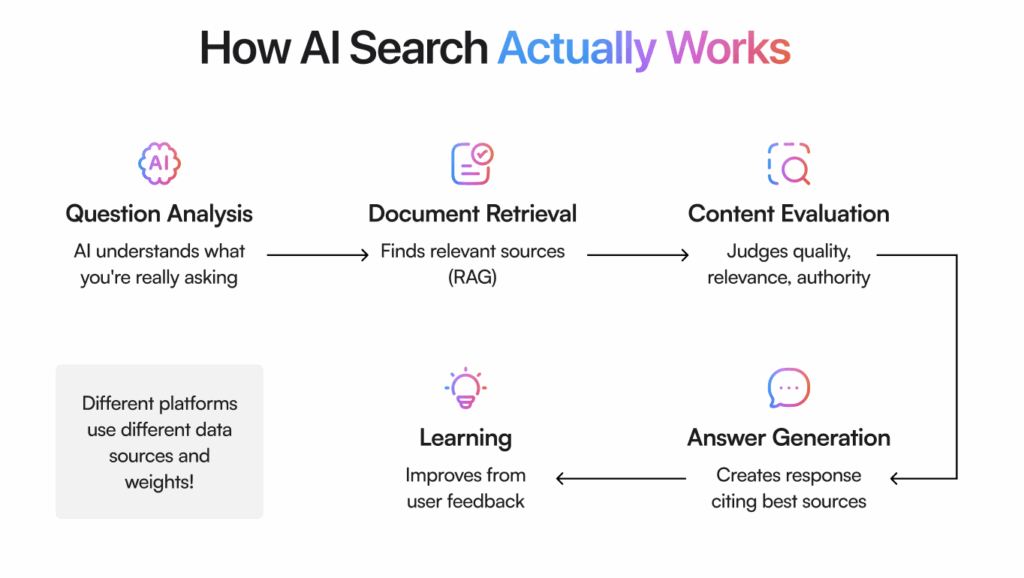
Google’s new AI Search SEO results are here to stay. To survive, you must adjust to them.
What should SEOs focus on? Not just keywords, but the technical fundamentals.
“Can the machines [LLMs] traverse your site and retrieve the content, and is the content retrievable in the way you need it to be retrievable?”
Think of an LLM as a very fast, very picky research assistant. Your job is to make your content easy for that assistant to read and quote accurately.
- Remove Hiding Spots: Some AI models only read the first layer of content (the part a user sees immediately). If your most important facts are hidden in accordions, toggles, or tabs, the AI might miss them. You must bring that key information to the surface.
- The Clarity Check: The new rule is: If the machine can’t easily find and understand your message, it won’t be featured in the AI summary.
The Rise of AI-Friendly Writing and Prompt-Led SEO
The transition to generative AI search is fundamentally changing the act of content creation. We are no longer writing for a human reader alone; we are writing for two audiences simultaneously: the human user and the Large Language Model (LLM). This dual audience demands a new discipline: AI-Friendly Writing, where content is optimized for immediate, accurate machine ingestion.
This shift makes the new skill of prompt engineering critical, not just for talking to the Future of AI Search SEO tools, but for optimising the content that AI tools read.
Why Prompt-Led SEO is Essential
Traditional SEO focused on keywords and readability for humans; Prompt-Led SEO focuses on clarity, structure, and verifiability for machines. When a user asks Google, ChatGPT, or another AI engine a question, that system must quickly scan billions of pages to synthesize an answer. Your content must be the easiest, most reliable, and most structured source to cite.
1. Forget Rambling: Embrace Structured Answers
LLMs excel at extracting information from clear, predictable patterns. Long, rambling paragraphs, while sometimes engaging for humans, are inefficient for an AI seeking a specific data point.
- The Solution: Successful content now uses a clear, logical structure that mirrors the way an AI processes information:
- Bulleted Lists and Numbered Steps: Use these formats instead of dense text blocks to break down complex processes, steps, or benefits. This directly signals to the LLM, “Here are discrete, quotable facts.”
- Question and Answer (Q&A) Format: Structure subheadings and paragraph beginnings as explicit questions followed by direct answers. This aligns perfectly with how AI Overviews and chatbots frame their responses.
2. Use Fact Boxes as Direct Signals
An LLM’s primary goal is to provide a concise summary. You can significantly increase your chance of citation by giving the machine a pre-packaged answer.
- The Solution: Start long articles with an executive summary, a “Key Takeaways” box, or a “TL;DR” (Too Long; Didn’t Read) summary.
- This box acts as a direct signal to the AI that clearly states, “This short paragraph contains the definitive answer or core concept of the entire article.”
- AI models often read this upfront content first. By placing your most valuable, citable information here, you maximize the chance of earning a prominent citation or Featured Snippet.
3. Boost Authority for Trust and Quotability
LLMs, like Google’s algorithms, prefer to quote sources they trust. This trust is built on your website’s fundamental signals of Experience, Expertise, Authoritativeness, and Trustworthiness (E-E-A-T).
- Internal Linking as a “Topic Map”: Use strong internal linking to connect related pieces of content. This signals to the AI that you have deep, comprehensive coverage across an entire topic cluster, establishing you as the domain authority. The AI trusts a site that provides all the context.
- Schema Markup is Proof: Use proper schema markup (especially for facts, FAQs, and author profiles). This explicitly tells the AI, “We are the expert on this topic,” providing machine-readable verification of the content’s validity and author’s credentials.
By implementing these strategies, you move beyond simple keyword optimization and begin to optimize your content for machine comprehension, effectively teaching the AI why you are the best source to quote.
Why “Search Everywhere” Matters More Than Ever
Shelby’s vision means you can no longer be a Google-only brand. You must adopt a “Search Everywhere” strategy to capture users across the fragmented web.
Where are users searching now?
- YouTube/TikTok (VSEO): These platforms are now search engines, especially for young people looking for “how-to” or product reviews. Optimize your video titles, descriptions, and captions like a blog post.
- Amazon & Marketplaces: If you sell a product, many purchase decisions start here. Optimize your product listings, images, and reviews; that’s where the commercial search intent lives.
- Brand Queries: In the end, the most valuable traffic is when a user searches specifically for your brand name. Focus your strategy on becoming the trusted name that people deliberately seek out, insulating you from any algorithm change.
Technical SEO for the AI Era: A Complete Accessibility Guide
Shelby’s focus on the technical side requires a tangible action plan. These steps ensure AI crawlers (like Google’s new agents or third-party LLMs) can access, understand, and trust your content.
| Technical Action | Why It Matters for AI/LLMs |
| Allow listing to AI Bots | Just like Googlebot, AI crawlers have specific user agents. Check your robots.txt and firewall to ensure they are not blocked and are allowed to crawl. No access means no citations. |
| Semantic HTML | Use clean, proper HTML tags (<h1>, <h2>, <article>, <main>). This tells the AI what the page is about and what the most important parts are. |
| Schema Markup | This is “machine language.” Use JSON-LD to label facts like FAQs, product prices, reviews, and event times, making them instantly citable in an AI summary. |
| Visible Dates | AI values freshness. Make sure publish and update dates are easily visible and clearly marked so the AI knows your information is current. |
| Server Speed | Fast response time is always important. If your server is slow, the AI crawler may time out and move on before it finishes reading the page. |
Zero-Click SEO and AI Citations: How to Track What Actually Matters
If Google is providing the answer directly through an AI Overview, your click-through rate (CTR) is likely to drop. This means the way you measure success has to change.
- Zero-Click SEO: If your content is used in an AI-generated answer, you’ve achieved Zero-Click SEO. You won’t get the click, but you get the massive brand visibility and authority boost.
- Track Impressions and Citations: The new key metrics are:
- Impressions: How often your page appears underneath an AI summary.
- Citations: How often your brand or domain is specifically mentioned in the AI-generated answer.
- The Conversion Shift: Since AI often summarizes informational content, SEOs should shift content strategy toward more transactional keywords, the ones where users have to click through to buy a product, sign up, or fill out a form.
What SEO Marketers Should Focus On Right Now
When asked for her final advice to AI Search SEO professionals, Carolyn Shelby pointed to a truth often forgotten in the scramble for rankings: while a good marketing strategy is vital and frequently overlooked, the technical fundamentals are where immediate action is required.
In the generative SEO for AI search era, this technical focus isn’t just about Google’s crawlers; it’s about preparing your site for Large Language Models (LLMs).
Prioritize Machine Accessibility
Shelby’s core message is to audit your site from an LLM’s perspective, emphasizing content accessibility at the machine level.
“I think focusing on the technical fundamentals. Can the machines [LLMs] traverse your site and retrieve the content and is the content retrievable in the way you need it to be retrievable?”
This means SEOs must acknowledge that different LLMs access content differently. Carolyn noted that some platforms, like Anthropic, capture only the first-view content, often missing information hidden in interactive elements like toggles or tabs.
Un-Hide Your Core Message
Your job is to ensure your most important message is immediately available for ingestion:
“Your job is to figure out what is being found and making sure that the things that the message that you need to have conveyed is in that stuff that is being read. If it’s not, if it’s hidden in something, you have to unhide it.”
Ultimately, the SEO job boils down to this: making sure your content is accessible and that the message you want seen is the message the machine can easily retrieve and quote.
The Future of SEO Is Human + Machine Alignment
Carolyn Shelby’s message is a clear call to action: Stop ignoring AI Search SEO and get your technical house in order.
The message is clear and non-negotiable: the age of content-for-cash SEO is over. The future belongs to those who successfully align with both human and machine audiences. Stop chasing ephemeral algorithm updates and return to the fundamentals that AI models are now prioritizing.
Your immediate survival depends on a dual strategy: technical excellence (to be crawlable and citable) and verifiable expertise (to be trustworthy). When your technical code is clean and your human expertise is evident, you become the ultimate source of truth, the only entity both the user and the LLM will choose.
The blog post you just read confirms it: AI Search SEO deserves the Hype and it requires a complete shift in strategy. If your content isn’t structured for immediate machine citation, you’re already losing visibility and revenue.
Don’t wait for your traffic to vanish.
DigiXL Media specializes in Human + Machine Alignment. We audit your technical code, restructure your content for guaranteed AI accessibility, and implement the technical E-E-A-T that LLMs trust. We ensure your brand is cited first, not lost.
Get started today! Claim your first free AI Content Optimization Audit with our specialised team of experts to upgrade your strategy.