Google’s search experience is evolving faster than at any point in the last decade. With AI Overviews and the new AI Mode rolling out globally, search is no longer just about matching keywords; it’s about meeting intent in a more dynamic, multimodal, conversational way.
For site owners, marketers, and creators, this shift brings a mix of excitement and uncertainty. On one hand, Google’s AI experiences can surface your content more prominently than ever. On the other hand, they change how users discover, evaluate, and engage with information on the web.
The good news? The foundations of good SEO haven’t changed. What has changed is the level of clarity, structure, and value your content now needs to stand out not just in classic SERPs but inside these new AI-powered experiences.
Below are the top ways to ensure your content performs exceptionally well in Google’s evolving AI ecosystem, explained in detail and with real-world relevance.
What Are Google AI Overviews?
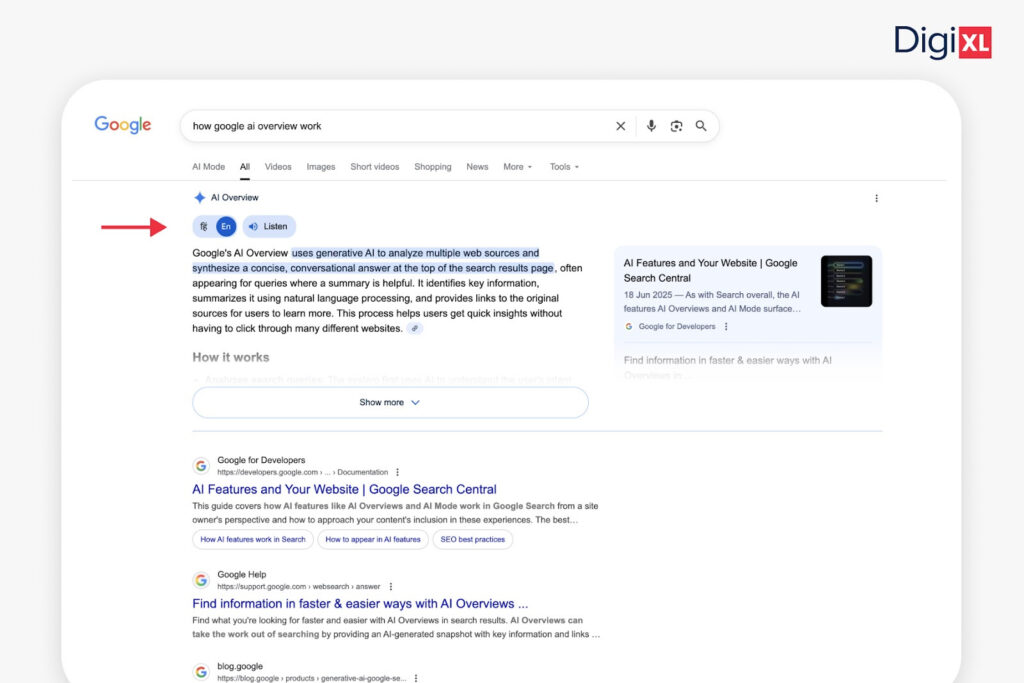
Google AI Overviews are Google’s new way of answering search queries using generative AI directly at the top of the results page. Instead of showing a list of links first, Google pulls information from multiple trusted sources, summarises it, and presents a quick, contextual answer that helps users understand a topic instantly.
Think of it as Google doing the research for the user. It scans the web, interprets intent, and delivers a concise explanation, often paired with links, product suggestions, or follow-up questions. These overviews don’t replace traditional search results, but they change how users discover them. People no longer need to click multiple pages to get the basics; Google gives them a head start.
From a marketer’s perspective, this matters because AI Overviews sit at a critical point in the journey. They capture attention earlier, influence how people explore deeper, and highlight specific websites as “supporting sources.” Those supporting links can drive high-intent traffic if your content is structured, credible, and AI-friendly enough for Google to surface it.
The Real Impact of Google’s AI Overviews on Websites
Google’s AI Overviews are reshaping how users interact with search results, and the ripple effects are already visible across industries. Because the overview appears before the traditional blue links, it naturally shifts user attention. People get the core answer instantly, which means they often skip the “click and explore” behaviour we’ve optimised for over the last decade.
For many publishers, this has led to a dip in clicks for broad, informational queries. Users who only needed definitions, summaries, or quick comparisons now find everything they want inside the overview itself. This isn’t a traffic collapse, it’s a recalibration of what types of content continue to earn clicks.
But here’s the part many marketers miss:
Websites that provide depth, expertise, and clear topical authority are seeing the opposite effect. When Google cites a site as a “supporting source” in the overview, click-through rates can actually increase. These placements act as trust signals, sending users who want more context or actionable steps directly to the linked pages.
In practice, AI Overviews have shifted website performance in three big ways:
- High-level content loses passive clicks, especially “what is” or definition-style pages.
- In-depth, actionable content gains visibility, because Google leans on credible sources to support its AI-generated summaries.
- Content quality matters more than keywords, as Google evaluates whether your page can genuinely validate or enrich the overview.
So while AI Overviews may reduce low-intent browsing, they reward websites that produce genuinely useful, structured, and authoritative content.
Proven SEO Tactics to Stand Out in Google SGE Results
Google’s Search Generative Experience (SGE) rewards content that is clear, credible, and easy for AI systems to interpret. Traditional SEO signals still matter, but the way you implement them needs to evolve because SGE isn’t ranking pages based on keyword density, it’s ranking them based on how confidently the AI can use your content to support its summary.
Here’s how to make your site more SGE-friendly:
1. Create Unique, People-First Content That AI Wants to Cite
If there’s one thing Google has made clear, it’s this: AI experiences are built to surface helpful, original, non-commodity content. AI Overviews rely heavily on summaries, definitions, and lists pulled from multiple credible sources. To become one of those sources, your content must:
- Answer questions clearly and completely
- Offer insights that aren’t available everywhere
- Demonstrate experience and expertise
- Provide value beyond the surface level
Think about what makes your perspective different: firsthand experience, tested frameworks, original data, or a unique angle. AI systems love content with substance because it helps them generate richer, more accurate answers.
If your page reads like a rewrite of existing content, it will struggle.
Your goal:
Be the source that explains things the clearest, not the one that explains what everyone else has already said.
2. Build Content the Way AI Overviews Like to Consume It
AI Overviews lean on specific content formats. If you want to show up, structure your pages with:
✔ A precise definition or summary
For “what is” and “how does” queries, Google often extracts the first 1–2 sentences.
Make your opening lines crisp, factual, and skimmable.
✔ Lists that actually add value
AI frequently uses bulleted or numbered lists in its expanded responses.
Include lists that:
- Summarize steps
- Break down concepts
- Compare options
- Highlight features
Don’t add lists for the sake of SEO, make them meaningful.
✔ Unique visuals
AI Overviews often show images and occasionally videos.
High-quality, original graphics outperform stock photos here.
If you operate in a niche, custom diagrams or labeled visuals can be extremely powerful.
✔ Short, clear sections with descriptive subheadings
The easier it is for Google to understand your page structure, the easier it is to cite you.
3. Invest in Page Experience, It Matters More Than Ever
Even the best content fails if the page experience is poor.
AI-referred traffic tends to be more engaged and more intent-driven. That’s good but only if your site is easy to navigate. Slow, cluttered, or distracting pages lose this advantage instantly.
Focus on:
- Clean layout
- Easily distinguishable primary content
- Reduced intrusive popups
- Fast load times across devices
- Logical page hierarchy
As more searchers land on your site from AI-powered results, their experience becomes a direct reflection of your quality and yes, it indirectly influences your visibility.
4. Nail the Technical Fundamentals
Technical SEO doesn’t disappear in the age of AI. In fact, it becomes even more important because AI Overviews can’t cite what they can’t crawl or index.
Check your basics:
- Ensure Googlebot isn’t blocked
- Serve clean HTTP 200 pages
- Avoid accidental noindex tags
- Maintain indexable, accessible content
- Optimize for mobile performance
- Reduce heavy scripts and slow JavaScript
If your site performance is weighed down by unnecessary files, trackers, or scripts, AI will find faster, more accessible competitors.
5. Use Preview Controls to Manage Visibility Wisely
Google provides publishers with flexible tools to control how content is displayed in AI-driven experiences, including AI Overviews. These controls allow you to manage the amount of content that Google can preview, snippet, or index, giving you a balance between visibility and content protection.
Key tools and what they do:
- nosnippet / data-nosnippet – Prevents Google from showing a text snippet from your page in search results or AI summaries. Ideal for sensitive information or proprietary content.
- max-snippet – Limits the length of the snippet Google can display. Useful for managing how much of your content is exposed upfront.
- noindex – Stops Google from indexing a page entirely. This removes it from both traditional search results and AI Overviews.
Best practices for using preview controls:
- Apply them strategically, not by default. Over-restricting can prevent your content from appearing as a source in AI Overviews.
- Use them for sensitive content, internal resources, or early drafts, rather than for pages you want to rank.
- Combine controls with structured content and metadata to ensure Google still understands your page’s context while controlling what is displayed.
Key takeaway: Preview controls are powerful, but overusing them can limit your visibility in AI-generated summaries. The smartest approach is to protect only what needs protection, while letting Google showcase your high-value, authoritative content.
6. Keep Structured Data Clean, Accurate, and Honest
Structured data continues to help Google understand your content. But it only works when it matches your visible on-page information.
To optimize for AI experiences:
- Follow Google’s structured data guidelines
- Use appropriate schema types
- Avoid marking up hidden or irrelevant content
- Validate with Google’s Rich Results Test
Matching schema to visible content sends a signal of reliability, something AI systems heavily lean on.
7. Embrace Multimodal Content, Search Isn’t Only Text Anymore
Google is now deeply multimodal: users can upload photos, record questions, or use screenshots to search.
To prepare:
- Add high-quality images with descriptive alt text
- Create supporting videos where relevant
- Keep your Google Business Profile and Merchant Center updated
- Use consistent product data across platforms
Multimodal search gives you new ways to appear, if you have content worth surfacing.
8. Measure More Than Clicks, Measure Value
When people arrive at your website from Google AI Overviews, they behave differently than typical search visitors. They’re usually more informed, having already read a concise summary of your topic in the AI snippet. They’re also more intentional, meaning they know what they’re looking for and are coming to your site to take specific actions. And finally, they’re more likely to engage, spending time exploring your content rather than bouncing immediately.
Because of this, traditional metrics like organic clicks don’t tell the full story anymore. You need to track deeper engagement to understand true performance:
- Average session duration: Are visitors spending time reading and interacting with your content? Longer sessions indicate interest and intent.
- Conversion events: Beyond clicks, track meaningful actions such as sales, newsletter signups, demo requests, or calls. These are the real outcomes.
- Content depth consumed: Are users exploring multiple pages or sections? This shows whether your site satisfies their informational needs.
- Engagement paths: Which pages or content formats are visitors navigating through? This helps optimize site flow and UX.
- Repeat visits: Are visitors returning? Returning traffic signals trust and loyalty.
The key takeaway is that clicks are just the start, not the end goal. For AI-overview-driven traffic, measuring how visitors interact, engage, and convert is what truly reflects your SEO success.
9. Keep Evolving With Your Users (and With Google)
Search has never stood still. From the 10 blue links to featured snippets, voice search, and now AI-driven Overviews, user expectations keep shifting and Google keeps adapting. AI Overviews aren’t just a new SERP feature, they’re a signal of how search is moving toward intent-driven, summarized, and multimodal experiences.
Brands that win in this environment don’t just chase clicks, they evolve alongside their users. That means continuously refreshing content, experimenting with formats, and tracking engagement beyond simple pageviews.
What expert SEOs are focusing on:
- Content refresh cycles: Update insights and data frequently to stay relevant in AI summaries.
- Diverse content formats: Combine text, video, images, tools, and interactive assets to match multimodal AI responses.
- Behavioral metrics over clicks: Track engagement paths, repeat visits, depth of content consumed, and micro-conversions.
- SERP & AI trend monitoring: Map changes in AI-organized results, conversational SERPs, and cross-platform search behavior.
- Continuous experimentation: Test new approaches, optimize iteratively, and learn from early adopters in your niche.
SEO has always rewarded adaptability. The difference today is that adaptation is faster, data-driven, and directly tied to how AI interprets your content. Brands that embrace this mindset will continue to be cited, referenced, and visible long after the initial AI rollout.
Final Thoughts
With SGE, Google has basically become a researcher that quotes sources it trusts, and your goal is to be one of those sources. That means your content needs to do more than cover a topic, it has to offer clarity, depth, and context that help Google’s AI build a stronger, more accurate answer.
Pages that are well-structured, easy to interpret, and backed by human expertise naturally become better candidates for citation inside AI Overviews. Instead of chasing keywords, the focus shifts to understanding user intent and addressing the real questions people ask before, during, and after the main query.
Covering topics comprehensively, keeping information fresh, and maintaining strong E-E-A-T signals all tell Google’s AI that your content is reliable enough to support its summaries. In SGE, visibility isn’t given to the loudest page, but to the most useful one.
If you want to refine your content strategy and position your website as a trusted source in AI-driven search, DigiXL Media can help you build a tailored roadmap. Let’s get your expertise surfaced where it matters. Let’s get on a call to discuss more!