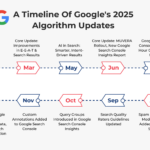
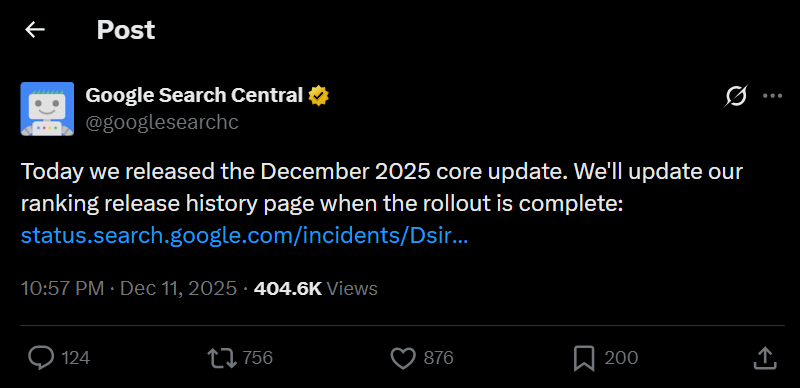
The rumors were right. Just as the SEO community noticed a massive spike in volatility earlier this week, Google confirmed the launch of the December 2025 Core Update. This marks the third and final major shift of the year, following the March and June updates.
Expect a 3-week rollout period as Google recalibrates to prioritize “satisfying, relevant content.” If your rankings have been riding a roller coaster the last 48 hours, you are not alone, the community chatter is hitting a fever pitch. With a spam update also under our belts from August, this core update puts a definitive cap on a high-volatility year for search.
Key Highlights of the December 2025 Core Update
Google just released its latest “Core Update.” Think of this as a major seasonal cleanup where Google reorganizes its “shelves” to make sure the best and most helpful websites are easier to find.
The Essentials:
- What is it? It’s called the December 2025 Broad Core Update.
- When did it start? Thursday, December 11, 2025.
- How long will it take? About three weeks to finish. Your rankings might bounce up and down until it’s done.
- Who does it affect? Everyone, everywhere. It covers all types of websites and every language.
Key Things to Know:
- It’s Not a Punishment: Google isn’t “fining” your site. It is simply trying to find and reward pages that people actually enjoy reading and find useful.
- Where will I see changes? You might see shifts in your regular search results, your Google Discover feed, or the “Featured Snippet” boxes at the top of the page.
- Why now? This is the third major update of 2025. If you noticed your traffic acting weird earlier this month, this update is likely the reason.
What to Do If Your Traffic Drops:
- Don’t Panic: Wait for the full three weeks to pass before making big changes.
- Review Your Content: Ask yourself: “Is this page truly helpful, or was it just written to rank on Google?”
- Make it Better: If you lost a spot, it usually means someone else’s page was more relevant. Focus on making your content clearer, more accurate, and easier to read.
- Stay Focused: Google makes small, quiet changes all the time. The best way to stay safe is to keep putting your readers first.
Google is spending the next three weeks reorganizing its search results to make sure the most helpful pages stay at the top. It’s a routine update, but they are staying on top of it to see what changes for you.
Google Core Updates Directly Impact Your Google Discover Feed Rankings
Google has officially confirmed that Core Updates influence your visibility in the Google Discover feed. While Discover is highly personalized to user interests, it relies on the same ‘quality metrics’ as Google Search. If a core update determines your site’s authority or relevance has shifted, your Discover traffic will likely follow suit. To succeed, you should follow the official Google Discover best practices, focusing on the core pillars of content quality: satisfying user intent, establishing authority, and using high-quality visuals.
What is a Google Core Update?
A Google Core Update is a major algorithm update that is released by Google to improve the quality and relevance of search results. These updates are designed to improve the overall user experience by providing more accurate and relevant search results to users.
Core Updates can have a significant impact on website rankings and traffic, as they can cause major shifts in the search engine results pages (SERPs). The updates are usually broad in scope, and they can affect a wide range of websites and industries.
Google typically releases several Core Updates each year, with each update focusing on different aspects of the search algorithm. Some updates may target specific types of content, such as low-quality or spammy websites, while others may focus on improving the overall user experience.
If your website is impacted by a Core Update, it’s important to review your site’s content and make any necessary improvements to ensure that it aligns with Google’s quality guidelines.
It may take some time to see the full impact of a Core Update, as Google continues to refine its algorithm and search results over time.
Google maintains that core updates do not specifically target individual pages or websites. Rather, their primary aim is to enhance the way their systems evaluate and assess content.
How Core Updates Work?
Google Core Updates are significant updates to Google’s search algorithm, which aim to improve the quality and relevance of search results. These updates are typically broad and impact a wide range of websites and search queries.
Google’s core updates are usually released several times a year, and they are designed to evaluate and adjust the way Google’s search algorithm evaluates and ranks web pages.
Google has not provided specific details about how core updates work, but they have said that the updates are based on changes to Google’s algorithms and the way they evaluate the relevance and quality of websites.
They also consider user feedback and user experience when designing these updates.
After a core update, website owners and webmasters may notice changes in their website’s search rankings, traffic, and visibility.
Websites that provide high-quality content and a good user experience are typically rewarded with higher rankings, while websites that violate Google’s guidelines or have low-quality content may see a decrease in their rankings.
To optimize for Google Core Updates, it’s important to focus on creating high-quality, relevant content, improving website user experience, and following Google’s guidelines for SEO.
Website owners should also monitor their website’s performance after a core update and make any necessary changes to improve their rankings and visibility.
Signs A Google Core Update Affected Your Website
When a Google Core Update is released, it can have a significant impact on search rankings and traffic for many websites. Here are some signs that a Google Core Update may have affected your website:
Significant Changes in Search Rankings
If you notice that your website’s search rankings have dropped significantly for some or all of your target keywords, it may be a sign that your website has been impacted by a Google Core Update.
Traffic Fluctuations
A Google Core Update can cause fluctuations in traffic to your website. If you notice a significant increase or decrease in traffic, it may be an indicator that your website has been affected by the update.
Changes in Click-Through Rates
If your website’s click-through rates (CTR) from search results have changed, it could be a sign that Google has made adjustments to how they evaluate and present search results.
Changes in the Featured Snippets
If your website has featured snippets or other rich results in the search results, changes in the way Google displays these results could impact your traffic and visibility.
Changes in Google Analytics Data
A Google Core Update may also impact your website’s Google Analytics data, such as bounce rates, time on site, and other engagement metrics.
It’s important to note that not all changes in search rankings or traffic are necessarily due to a Google Core Update, as many factors can influence search results.
However, if you observe any of these signs, it may be worth investigating whether a recent update has affected your website.
Marketers Affected by the Update
When a website encounters a decline in its rankings following a core update, it becomes essential to scrutinize the disparities and pinpoint potential areas for enhancement.
How to Recover from a Google Core Update?
Recovering from a Google core update can be a challenging process, but there are several steps you can take to improve your website’s visibility in search results:
Analyze Your Website
First, thoroughly analyze your website to identify the areas where the core update has impacted you. Utilize Google Analytics and other SEO tools to comprehend the decline in traffic and rankings.
Understand Google’s Guidelines
Make sure you understand and follow Google’s guidelines for high-quality content and website user experience. Check for duplicate content, low-quality pages, broken links, and other technical SEO issues.
Improve Your Content
Create high-quality content that meets the user’s search intent. Focus on providing value to the user with informative and engaging content. Make sure that your content is original and offers unique perspectives on the topic.
Improve Your User Experience
Optimize your website’s user experience to improve engagement and reduce bounce rates. Ensure that your website is mobile-friendly, has fast page load times, easy navigation, and clear call-to-action buttons.
Build High-Quality Backlinks
Focus on building high-quality backlinks from authoritative and relevant websites. Avoid spammy and low-quality backlinks that can harm your website’s reputation.
Be Patient
Recovery from a Google core update can take time, and you may not see immediate results. Keep monitoring your website’s traffic and rankings and make necessary changes to improve your website’s performance.
Remember, recovering from a Google core update is a long-term process. By following the above steps, you can improve your website’s visibility in search results and regain your lost traffic and rankings.
Previous Core Updates
1. June 2025 Core Update
The June 2025 Core Update concludes its rollout. After nearly 17 days, Google confirmed the update finished on July 17, 2025. The process began on June 30 and took exactly 16 days and 18 hours to fully deploy across search results.
2. March 2025 Core Update
Google announced the release of its March 2025 core update, describing it as a routine update aimed at delivering more relevant and valuable content across all types of websites. The company also emphasized its ongoing efforts to enhance the visibility of creator-driven content, with several improvements already implemented and more expected later this year.
3. December 2024 Core Update
The December 2024 core update, likely the final one of the year, has now fully rolled out. It began on December 12, 2024, and was completed by December 18, 2024. As with previous core updates, this update focused on refining Google’s ranking systems to enhance the relevance and usefulness of search results.
4. November 2024 Core Update
Google has completed the rollout of its November 2024 core update. The process began on November 11, 2024, and finished on December 5, 2024, lasting approximately 24 days. A Google representative confirmed this information. This update was a standard core update, which involves Google improving its main ranking system to enhance the relevance and usefulness of search results.
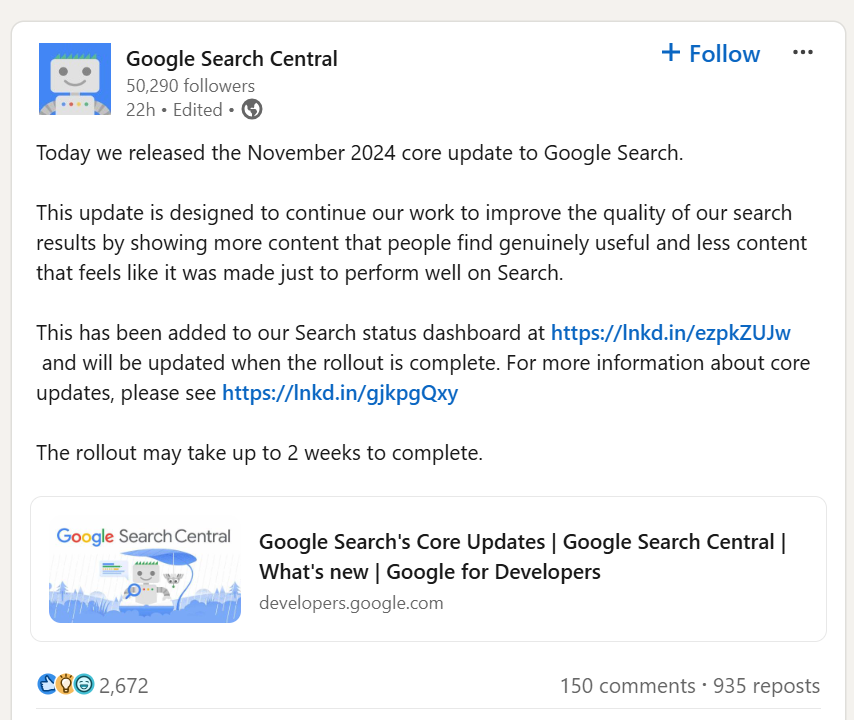
Google’s main advice remains consistent: create helpful content for people, not search engines. They’ve stated:
“There’s nothing new or special creators need to do for this update if they’ve been making satisfying content for people. If you’re not ranking as well as you’d like, we strongly suggest reading our guide on creating helpful, reliable, people-first content.”
5. August 2024 (Revised) and Spam Policies
Google has released a core algorithm update in August 2024 aimed at improving search results by prioritizing high-quality content and reducing the visibility of low-value SEO-focused material. The full implementation of this update is expected to be completed within a month.
Now Google has included new instructions on utilizing Search Console to evaluate traffic drops. The revised document places greater emphasis on actionable steps for websites that have been affected. Google made the following announcement on X and changed the search updates page:
Additional Updates (NEW)
Google has revised its core algorithm update guidance again, offering more comprehensive recommendations for websites affected by these changes.
6. March 2024 – Core Update & New Spam Policies
Google’s March 2024 core update was a significant algorithm overhaul designed to enhance search results by prioritizing informative, comprehensive, and well-researched content. This update refined Google’s ability to assess content quality, placing a stronger emphasis on user-focused material. To further improve search quality, Google also implemented stricter policies against spam and manipulative tactics, including penalties for abusing expired domains, low-quality content, and deceptive website practices.
7. November 2, 2023 – Broad Core Update
Google made a major change to how it finds websites for your searches (called a core update). This update, finished in November 2023, aimed to show you better quality results and reduce unhelpful content. It was one of several updates Google made throughout that year.
8. October 19, 2023 – Core Search Algorithm Update
The rollout of Google’s October 2023 core search update has concluded, designed to enhance rankings by prioritizing high-quality content.
The objective of the update was to enhance rankings through the promotion of quality content. Additionally, the update featured a spam improvement targeting various reported spam types in Turkish, Vietnamese, Indonesian, Hindi, Chinese, and other languages.
9. August 22, 2023 – Core Update
The update commenced on August 22, 2023, and wrapped up on September 7, 2023, spanning a duration of 16 days.
10. March 15, 2023 – Core Update
On March 15, 2023, Google announced its first extensive core search algorithm update of the year. This update, known as the March core update, is intended to affect all content categories across various regions and languages.
Its primary objective is to elevate or acknowledge web pages that offer significant value.
11. September 12, 2022 – Core Algorithm Update
On September 12, Google disclosed a modification to their Core Algorithm Update, and they fully implemented the upgrade on September 26.
Website owners interested in delving deeper into these key improvements can find additional information on the Google Search Central Blog.
12. August 2022 – Helpful Content Update
The 2022 Helpful Content Update introduced a sitewide ranking signal focused on rewarding people-first content. It penalized SEO-driven pages that lacked originality or value, pushing creators to prioritize genuine, helpful information written with real users in mind.
13. May 2022 Core Update
Google released the May 2022 Core Update, as they announced in a tweet. This represents one of several adjustments that Google implements in its overall ranking system throughout the year.
The revision commenced on May 22, 2022, and concluded on June 9, 2022.
14. November 17, 2021 – Broad Core Update
Later that day, Google Search Central announced a significant core upgrade through Twitter.
They directed webmasters to their documentation, last updated in August 2019, for information about what site owners should understand regarding core upgrades.
15. July 2021 Core Update Completed
The distribution of the July 2021 Core Update definitively finished on July 12th, according to Google Search Liaison’s confirmation on Twitter. No other information was given.
16. July 2021 Core Update
The July 2021 Core Update is rolling out and will take one to two weeks to finish, according to a tweet from Google Search Liaison. The Google Search Central Blog contains instructions from Google regarding fundamental changes.
17. June 2, 2021- Broad Core Algorithm Update
Danny Sullivan, the Google Search liaison, tweeted about the imminent release of a significant core algorithm upgrade. He noted that some anticipated improvements weren’t fully prepared for this update, so these elements will be included in a second broad core algorithm change scheduled for July.
18. December 3, 2020, Core Update
Google announced that they would release the December 2020 Core Update on December 3, 2020. This marks the third revision of the primary algorithm this year.
Quite a long time has passed since the most recent core upgrade, compared to the average gap between these kinds of modifications.
19. May 4, 2020, Core Update
Danny Sullivan, the liaison for Google Search, tweeted that Google would be launching a significant upgrade to its core algorithm. He indicated the update was starting to roll out and would take 1-2 weeks to finish about 90 minutes later.
20. January 13, 2020, Core Update
Google’s Danny Sullivan tweeted the impending deployment of a major core algorithm upgrade. In line with its approach for all recent broad core algorithm improvements, Google once again provided advice.
21. September 24, 2019, Broad Core Algorithm Update
According to a tweet from Danny Sullivan, Google would launch a broad update to its core algorithm in a few hours, and it would take a few days to fully roll out.
The advice provided by Google was the same as it had been for all prior recent upgrades to the core algorithm.
22. June 2, 2019, Core Update
On June 2, Danny Sullivan, Google Search Liaison, tweeted that Google would release a new broad core algorithm upgrade on June 3. The following day, Google announced that the update was operational and would gradually roll out to all its data centers.
Google claims that there is nothing specific to address because a core update takes a broad variety of things into account, as is the case with each major update to the core algorithm.
23. March 12, 2019, Core Update – Florida
Google’s Search Liaison, Danny Sullivan, confirmed via Twitter that they have released a global broad core algorithm update.
This upgrade is one of the most significant and significant Google updates in recent memory, according to SEJ. Sullivan reiterated its recommendation to adhere to the instructions it gave after the March 9, 2018 update.
24. 2018: Medic Update
Focus: E-E-A-T for YMYL (Your Money or Your Life) sites
Though not exclusive to health, the Medic update had the biggest impact on health, wellness, finance, and legal websites—any site that could affect a user’s well-being or financial decisions.
It emphasized Expertise, Authoritativeness, and Trustworthiness (E-E-A-T), rewarding sites that demonstrated credible authorship, high-quality content, and strong reputations.
25. 2018: Mobile Speed Update
Focus: Page speed on mobile
Building on mobile-first indexing, this update made page speed a ranking factor for mobile searches, pushing sites to deliver fast-loading experiences for smartphone users.
It penalized slow mobile websites, even if they had good content.
26. 2018: Mobile-First Indexing
Focus: Mobile over desktop
With the shift to mobile browsing, Google officially switched to indexing the mobile version of a website before the desktop one.
Websites not optimized for mobile risked lower rankings, especially if the mobile version lacked key content or structured data present on the desktop site.
27. 2015: RankBrain
Focus: Machine learning & query interpretation
RankBrain marked Google’s first major use of artificial intelligence (machine learning) in search.
It helped Google interpret unfamiliar or complex queries and understand search intent, improving result relevance even when exact keywords weren’t used.
RankBrain is still considered a core part of Google’s algorithm and one of the top ranking signals.
28. 2015: Mobile-Friendly Update (“Mobilegeddon”)
Focus: Mobile usability
Google rolled out this update to give priority to mobile-friendly websites in mobile search results.
It was a response to the growing mobile user base, encouraging webmasters to design sites that were responsive, readable, and fast-loading on smaller screens.
29. 2014: Pigeon
Focus: Local search
Pigeon was a major update to how local search results were ranked. It strengthened the connection between Google’s local algorithm and core search algorithm, giving more weight to traditional ranking signals (like domain authority) in local results.
It improved accuracy for searches with local intent by better using location cues—allowing users to see results closer to their physical location, not just city-wide listings.
30. 2013: Hummingbird
Focus: Semantic search & intent
Hummingbird was a complete overhaul of Google’s core search algorithm, allowing it to better understand the intent behind search queries, rather than just matching individual keywords.
It introduced the ability to process longer, conversational, and voice-based queries, improving results based on context, relationships between words, and overall searcher meaning.
31. 2012: Penguin
Focus: Link quality
Penguin targeted websites that used manipulative link-building practices such as buying backlinks or participating in link schemes—to boost their rankings.
Its goal was to reward natural link profiles and penalize those using spammy or irrelevant backlinks, shifting the focus toward genuine authority and relevance over quantity of links.
32. 2011: Panda
Focus: Content quality
The Panda update was introduced to reduce the rankings of websites with low-quality, thin, or spammy content especially so-called “content farms” that mass-produced articles to manipulate rankings.
It rewarded websites offering original, useful, and in-depth content, helping ensure users were directed to more relevant and trustworthy sources in search results.
Conclusion
The June 2025 Broad Core Update serves as another reminder that Google’s focus remains firmly on rewarding content that is genuinely helpful, trustworthy, and aligned with user intent.
While these updates can cause noticeable shifts in rankings, the long-term strategy remains the same prioritize quality over shortcuts. If your site is built on strong E-E-A-T principles and delivers real value to your audience, you’re already moving in the right direction. Keep monitoring your performance, be open to improving where it counts, and let this update guide you toward more sustainable SEO practices.
Want to stay ahead of every Google update without the guesswork? Follow DigiXLMedia for expert SEO insights, algorithm breakdowns, and actionable tips to keep your content ranking where it belongs at the top. Follow our socials for regular updates! LinkedIn, X, and Facebook.