As we stand at the end of 2025, looking back at the last twelve months of Search and Google Algorithm Updates is like looking at a different era of the internet. If 2024 was the year of “AI hype,” 2025 was the year of AI integration. It was the year Google stopped treating AI as a side project and started treating it as the very fabric of the search experience.
For SEOs and digital marketers, 2025 hasn’t just been about chasing rankings; it’s been about managing complexity. We’ve seen a shift from “traditional search” to a hybrid model where visibility is dictated by technical precision, entity-based relevance, and a rock-solid foundation.
In this comprehensive recap, we’ll dive deep into the major Google algorithm updates, the revolutionary changes to Google Search Console, and the new technical standards that now define success in the modern search landscape.
1. The Core Update Trilogy: March, June, and December
Google Algorithm Updates maintained its rhythm of “broad core updates” this year, but each one carried a distinct personality and impact.
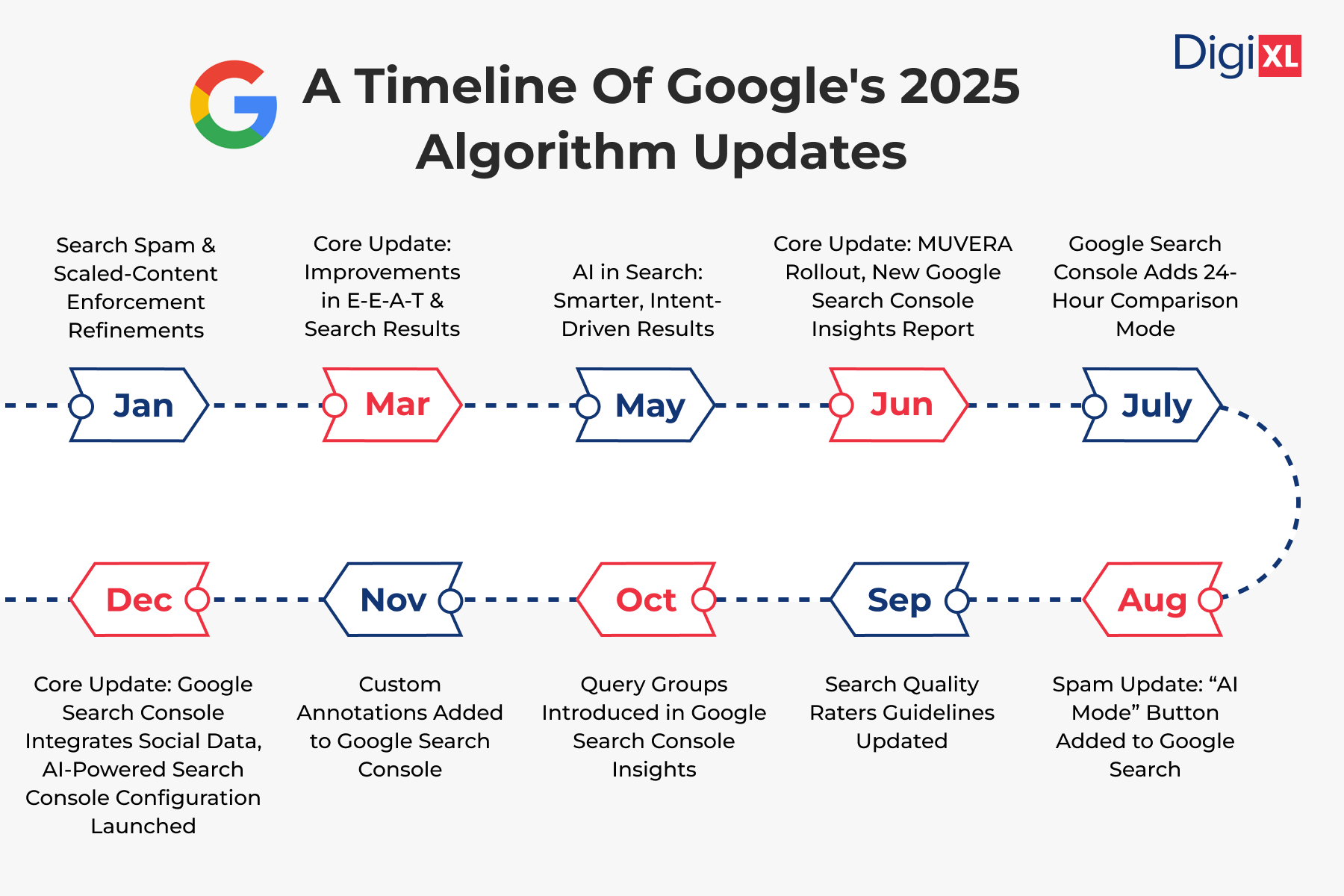
The March 2025 Core Update
The year started with a bang. On March 13, Google kicked off the March 2025 Core Update rollout that would last exactly two weeks. This wasn’t a “business as usual” update. Data from tracking systems like Local SEO Guide, which monitors over 100,000 home services keywords, showed unprecedented movement.
For many, this update was a significant cleanup. Sites that relied on legacy tactics or thin content saw massive shifts. The update prioritized user intent fulfillment over keyword density. If your page was designed to rank but not to help, March was likely a difficult month for you.
The June 2025 Core Update
While the March update felt like a sledgehammer, the June update felt more like a scalpel. Many SEOs noted that while the movement was significant, it didn’t feel as “disruptive” to the general web. The reason? Google was busy upgrading its backend architecture.
The June 2025 Core Update coincided with two major breakthroughs: MUVERA and the Graph Foundation Model.
- MUVERA (Multi-Vector via Fixed Dimensional Encodings): Announced officially on June 25 (though the research had been brewing since 2024), MUVERA is a retrieval algorithm that allows Google to understand web pages through multi-vector analysis. In simpler terms: Google got much better at matching complex, nuanced queries to the exact right section of a webpage, even if the keywords didn’t match perfectly.
- The Graph Foundation Model: This improved how Google understands the relationship between “entities” (people, places, things, and brands).
The result was a SERP that felt more “accurate” but less volatile for high-quality, authoritative sites.
The December 2025 Core Update
Just as we were preparing for the holidays, Google Algorithm Updates dropped the December 2025 Core Update on December 11 at 9:25 a.m. PT. As of right now, this update is still rolling out and is expected to take up to three weeks.
Google has flagged this as an “incident affecting ranking,” which is their way of acknowledging that the shifts are broad and impactful. It serves as a final “sanity check” for the year, rewarding sites that have stayed consistent with quality throughout 2025.
2. Search Console’s Evolution: From Reporting to Command Center
The most visible changes for SEOs this year didn’t happen in the search results, but in the tools we use to measure them. Search Console (GSC) underwent its most significant transformation since its inception.
The Summer of Data (June & July)
Unified Visibility: Google Search Console Integrates Social Data. Google has officially expanded the Search Console Insights report to include social channel performance. This experiment marks a shift toward a more holistic view of brand discovery, recognizing that social media is now a critical touchpoint in the searcher’s journey. SEOs and strategists can now monitor their Google Search performance alongside their key social channels for a truly unified look at organic visibility.
On July 16, Google answered a decade-long prayer from the SEO community: 24-Hour Comparison Mode. This allowed for real-time analysis of site migrations, outages, or viral content spikes, giving us a granular look at performance that was previously impossible.
The Autumn of Analysis (November)
November was a busy month for Google Search Console. Two major features such as Query Groups and Custom Annotations, changed how we organize our workflow:
- Query Groups: SEOs could finally group keywords by “theme” or “intent” within the GSC Insights interface. No more exporting to Excel just to see how your “Product” keywords were doing versus your “How-to” keywords.
- Custom Annotations: Perhaps the most requested feature in history. We can now add notes directly to performance charts. “Launched new blog design,” “Fixed 404 errors,” or “Algorithm Update” can now be marked directly on the graph, providing context to every spike and dip.
The AI-Powered Winter (December)
December brought the future to our fingertips. On December 4, Google launched AI-Powered Configuration and Customization. This allows SEOs to use natural language analysis to query their own performance reports.
Instead of clicking through filters, you can now ask GSC: “Show me all pages that lost more than 20% of their mobile traffic compared to last month and tell me if they have Core Web Vital issues.”
Additionally, on December 8, Google began experimenting with Social Channels in GSC, showing clicks and impressions from platforms like TikTok and Instagram, a clear sign that Google views “Search” as a multi-platform ecosystem.
3. The August 2025 Spam Update
Between August 26 and September 22, Google Algorithm updates ran a global Spam Update. This was a targeted strike against the “mass-produced” content trend that dominated the early part of the year.
This update focused on:
- Aggressive AI-generated content that lacked human oversight or original value.
- Site reputation abuse, where high-authority sites hosted low-quality third-party content.
- Scaled content abuse, where domains were used to flood the SERPs with hundreds of variations of the same low-value page.
The takeaway from August was clear: if your content strategy is built on “volume at all costs,” your foundation is shaky, and Google’s systems are now sophisticated enough to spot it in real-time.
4. AI Mode and the New Search Experience
2025 was the year Google Search became “Search & AI Mode.” This isn’t just about a chatbot; it’s about how users interact with information.
Search Analytics API & Hourly Data
To support the fast-paced nature of AI search, Google improved the Search Analytics API to expose the HOUR dimension. This allows enterprise SEOs to see how their visibility fluctuates throughout the day, which is critical as AI-generated answers can change or update in real-time based on new information.
AI Mode Metrics
Google officially began including AI Mode data (clicks, impressions, and CTR) in Performance Reports. This was a monumental shift. We no longer have to guess if we are being cited in an AI summary; the data is right there.
Google also introduced:
- Preferred Source Highlighting: For users with news subscriptions, Google now highlights their preferred sources within the AI Mode answers.
- Increased Source Linking: Following feedback from publishers, 2025 saw a massive increase in the transparency of AI Mode, with Google linking to more sources and making citations more prominent.
5. Why Foundation is the Only Way Forward
As we look at the sheer volume of updates this year: the Core Updates, the MUVERA algorithm, the Spam strikes, a clear pattern emerges.
SEO projects in 2025 didn’t fail because of “bad keywords.” They failed because of a shaky foundation.
In the first 30 days of any project, identifying technical “landmines” has become the most critical task. To help you navigate 2026, we’ve identified the 8 Essential Audits that have become the non-negotiables in this AI world:
Audit 1: Technical Debt & Indexation Bloat
With Google becoming more efficient (thanks to MUVERA), they are also becoming more selective. If your site is cluttered with 404s, duplicate pages, or “zombie” content, you are wasting your crawl budget.
Audit 2: The Entity & Schema Map
In 2025, if Google doesn’t know who you are and what you represent, you won’t rank for the big terms. Your Schema markup needs to be impeccable to feed the Graph Foundation Model.
Audit 3: AI Mode Visibility & Citations
Are you actually showing up in the AI overviews? This audit looks at “citation-worthy” content data, original research, and unique perspectives that AI models are likely to cite.
Audit 4: Core Web Vitals & Real User Experience
With the Unified Insights in Google Search Console, we now know that page speed isn’t just a tie-breaker; it’s a fundamental ranking signal.
Audit 5: Content Gap & Intent Alignment
Is your content answering the query, or just repeating the keyword? Post-March 2025, intent alignment is the number one content priority.
Audit 6: Internal Link Architecture
How does authority flow through your site? A shaky internal link structure means Google can’t find your most important pages.
Audit 7: Backlink Health & Toxicity
Following the August Spam Update, cleaning up “low-quality fluff” links is more important than ever.
Audit 8: Local & Social Integration
With Google Search Console now showing social data, your “search” strategy must include how your brand appears on social platforms and in local maps.
6. Looking Ahead: Strategy for 2026
The 2025 recap teaches us that the “old way” of SEO, trying to trick a machine into liking your content, is officially dead. The “new way” is about transparency and precision.
Google is giving us more data than ever (hourly API data, AI metrics, annotations), but they are also holding us to a higher standard. As the December Core Update finishes its rollout, we enter 2026 with a clearer picture of what the search engine wants:
- Speed and Efficiency: Sites that load fast and make sense to the MUVERA algorithm.
- Trust and Authority: Sites that are recognized as entities in the Graph Foundation Model.
- Human-First Value: Content that survives a Spam Update because it wasn’t made by a machine for a machine.
The first 30 days of your next SEO project will determine your success for the next twelve months. Don’t let a shaky foundation blow up your rankings in the middle of 2026.
Join the Conversation
Which of the 2025 Google Algorithm Updates had the biggest impact on your traffic? Are you seeing your data in the new AI Mode reports yet? And most importantly, which of the 8 essential audits are you going to prioritize first as we head into the new year?
Make sure to follow us on LinkedIn, X and Facebook and share your insights with us!
At DigiXL Media, we specialize in identifying technical “landmines” and building the rock-solid SEO foundations that 2026 demands. Whether you need a deep-dive audit or a comprehensive strategy for the new AI search era, we are here to help your brand lead the way.
Book a Consultation with DigiXL Media Today to ensure your project starts with a rock-solid foundation.